
TDIH: The Seabees of the United States Navy
“The difficult we do now; the impossible takes a little longer.”

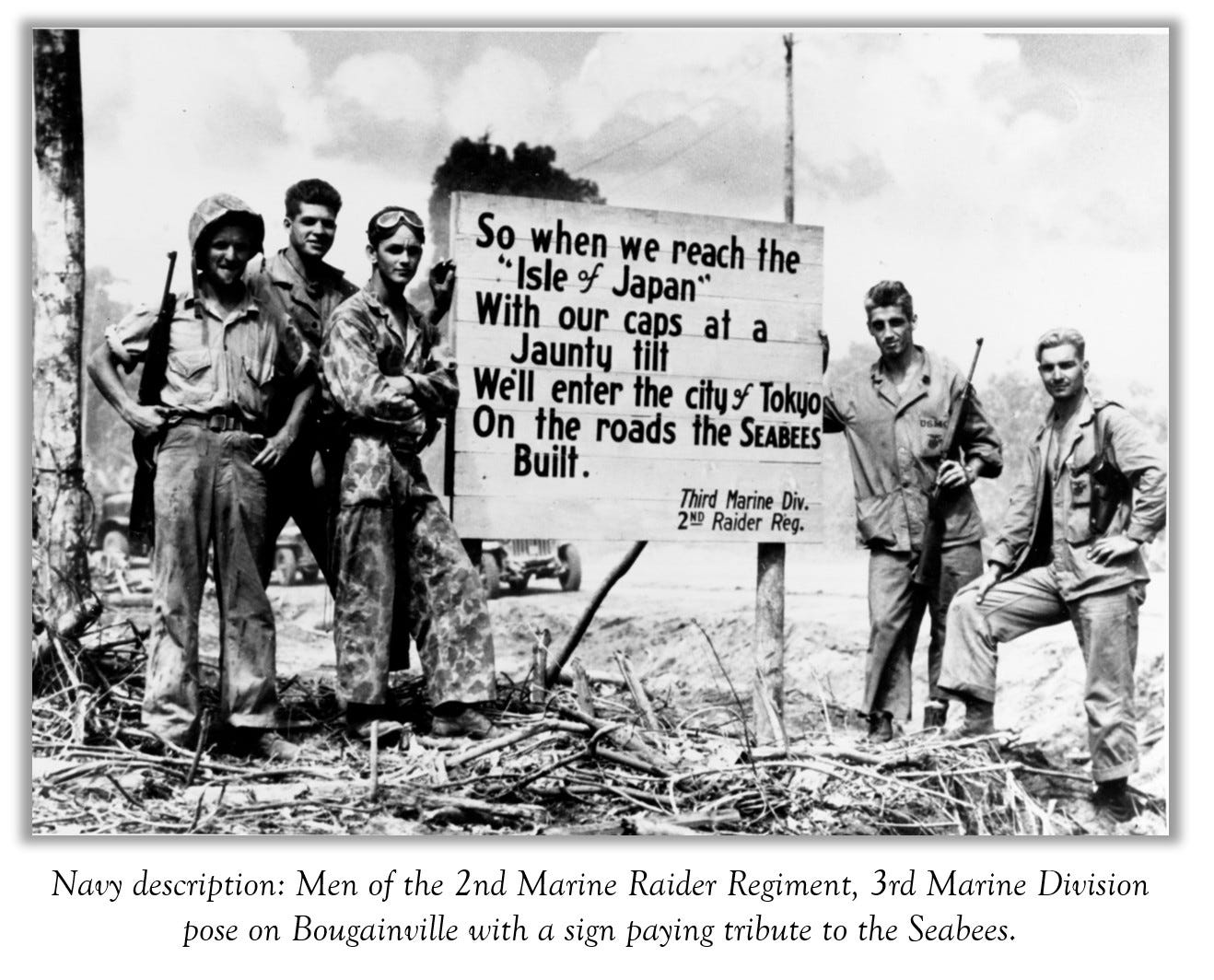
At about this time in 1942, the United States creates a different kind of fighting force. These men didn’t rely on rifles, though. Instead, they drove bulldozers, concrete mixers, and cranes. They operated jackhammers, shovels, and welding torches.
“The Seabees of the United States Navy were born in the dark days following Pearl Harbor,” the Naval History and Heritage Command (NHHC) website explains, “when the task of building victory from defeat seemed almost insurmountable. The Seabees were created in answer to a crucial demand for builders who could fight.”
Someone had to build the ports, roads, airstrips, and hospitals needed to win a war. Before World War II, the task was often delegated to private companies, but that solution had become impracticable.
“Under military law,” Rear Admiral Ben Moreell later explained, “civilians could not offer resistance when attacked. A civilian bearing arms would be considered a guerrilla, liable to summary execution if captured.”
Thus, Moreell asked for authorization to recruit tradesmen into the Navy. He wanted a force that could build facilities—but that would also be able to fight when needed.
He obtained approval on January 5, 1942. Then, on March 5, the Navy adopted a shoulder insignia—a carpenter bee holding a hammer, wrench, and gun—for the newly created Naval Construction Battalions. On March 19, Civil Engineer Corps officers were given command of these construction units.
Recruiting a Seabee was a bit different: The Navy needed skilled tradesmen, not novices. It actively wanted the older men rejected by other military branches.
“The first recruits were the men who had helped to build Boulder Dam, the national highways, and New York’s skyscrapers,” NHHC notes, “who had worked in the mines and quarries and dug the subway tunnels . . . . They knew more than 60 skilled trades.”
Seabees were supposed to be no older than 50, but a few in their 60s finagled their way in. The feat, NHHC says, was an “early manifestation of Seabee ingenuity.”
And ingenuity was desperately needed. The Seabees often worked in primitive conditions—at least until they could build something better. Creative solutions were required when supplies ran short.
For instance, they might use Coke bottles in place of glass insulators on power lines or crush up coral reefs to replace gravel.
Yet Seabees could be in the line of fire and had to be ready to fight, too. Their first such experience came at Guadalcanal.
The Japanese had abandoned an airstrip, and the Seabees were to get it up and running, even as the battle waged around them. They repaired the airstrip, then watched it get bombed again. The cycle of “bomb, repair, bomb, repair” continued for weeks.
“We found that 100 Seabees could repair the damage of a 500-pound bomb hit on an airstrip in 40 minutes,” one officer marveled.
Naturally, the Seabees stopped repairs long enough to push back the Japanese when they got too close. Then they went right back to work. Nor did they stop at airstrips. They built bridges, roads, and restored power plants, despite the conflict around them.
Their stunning performance convinced military planners that Seabees should land alongside invasion forces more often. Which is how the Seabees came to be at D-Day, too.
“[I]t is a little difficult to report on everything these SeaBees did,” Moreell concluded, “because they were so busy accomplishing impossible things that they had little time to make reports on how they did it.”
Today, of course, Seabees continue to live up to their motto: “We Build, We Fight.” They’ve been known to note that the “difficult we do now; the impossible takes a little longer.”
Determination. Perseverance. Making the impossible, possible. How AMERICAN.

Sources can always be found on my website, here.
"The difficult we do now; the impossible takes a little longer.” That's the sort of thing we need to teach our children: Do Hard Things! That's the American spirit.
I first learned about the Seabees from the John Wayne movie about them, "The fighting Seabees"! A great movie about them, thanks for the story Tara!