
TDIH: The Sacred Twenty
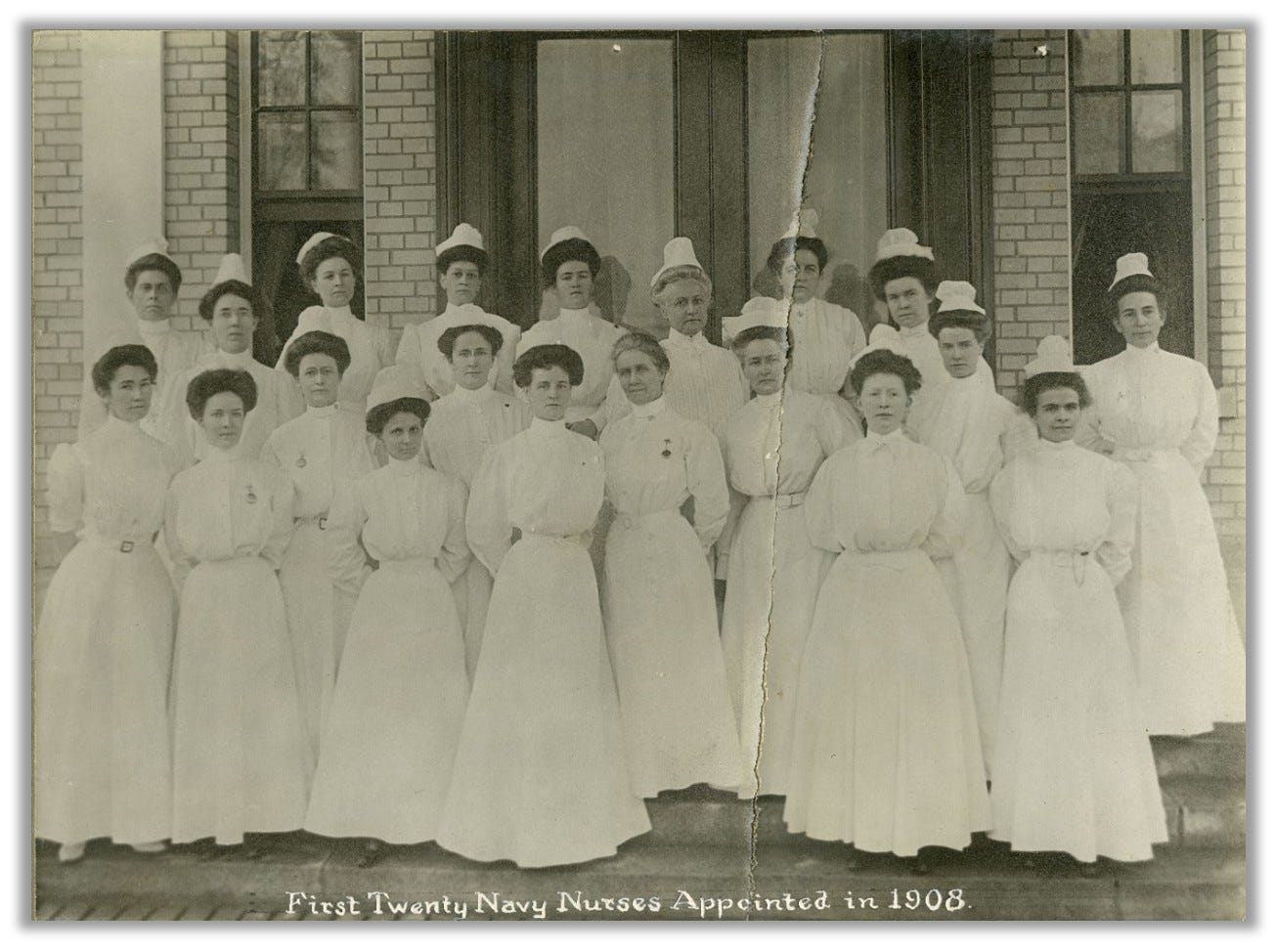
Twenty pioneering women were selected as the first nurses in the Navy Nurse Corps. Together, they came to be known as the “Sacred Twenty.”

At about this time in 1908, a new chapter begins for the United States Navy as a new Nurse Corps is authorized. Twenty pioneering women would soon be selected as the Corps’ first nurses. Together, they came to be known as the “Sacred Twenty.”
The idea of Navy nurses had been slow to take hold.
“The strongest resistance came from within the Navy itself,” historian Susan H. Godson explains. “Many older senior medical officers had never worked with women nurses . . . . They could only envision with horror ‘petticoat government’ in naval hospitals.”
Male hospital corpsmen were also worried about taking orders from women—or losing plum assignments to them. Nevertheless, a shortage of corpsmen proved to be a tipping point. A Naval Appropriations Act signed on May 13, 1908, finally created the Navy Nurse Corps.
Yet the Corps’ success would depend on its first nurses.
Veteran Army contract nurse Esther Hasson was chosen as Superintendent. She’d served aboard USS Relief during the Spanish-American War and later became a chief nurse in the Philippines. She would now be responsible for the first group of nurses.
Applications were accepted only from graduates of hospital training schools. Candidates traveled to D.C. at their own expense for oral and written exams and were evaluated for intangible qualities such as temperament and self-control.
Excellence in the Corps would be essential.
Ultimately, Chief Nurse Lenah Higbee and 18 other women were chosen to join Hasson in the new Nurse Corps.
“We learned rapidly the naval standards and the jargon of the Navy,” Higbee later said, but nurse Della Knight remembered that learning to pour tea for a commanding officer was also part of their early training. “A Navy nurse was expected, first of all, to be a lady,” Knight smiled.
The nurses had no formal rank and received pay of $40 per month. An allowance for sustenance was provided, but they otherwise had to fend for themselves. “[Nurses] rented a house and ran their own mess,” nurse Beatrice Bowman remembered. “These pioneers were no more welcome to most of the personnel of the Navy than women are when invading what a man calls his domain.”
In 1909, the nurses began receiving assignments outside of D.C. They performed so well that medical officers began asking for more nurses, despite their earlier misgivings. Before too long, the women had proven themselves so completely that they were tasked with training male hospital corpsmen.
“The corpsmen and the doctors opposed us,” nurse Sara B. Myer later laughed, “but they grew accustomed to us. The boys were very glad to see us—very glad! The old time corpsman, you see, operated on the theory ‘treat them too well, they stay too long.’”
The new naval nurses did the opposite, of course.
The Corps grew and nurses began traveling overseas in 1910. By the time the United States entered World War I, 190 nurses were in the Corps and Higbee had taken over as Superintendent. Now nurses were closer to the fighting, too.
“I don’t believe one of us had ever imagined men could be so absolutely ‘shot to pieces,’” nurse Mary Elderkins said. The nurses persevered, though, and nearly 1,400 were serving by the end of the war. Four received Navy Crosses, three posthumously.
“Though their contributions to the Navy cannot be measured in ships sunk or enemies engaged,” Naval History Magazine concluded, “Higbee and her nurses were as essential to victory in war as any military element.”
Today, as you know, nurses receive full military rank, and they serve all around the world. But it all started with the Sacred Twenty: A small group of pioneering women who were handed a challenge—and met it head-on.

Sources can always be found on my website, here.
Those who navigate uncharted paths are heroes to our nation. These women proved that for the US Navy. Thanks Tara. 🙏❤️💪🇺🇲
Military nurses have become a vital link to the military. I have read what nurses did in Vietnam to save many lives. The sacrifices of military nurses should be remembered as all military sacrifices. Let's remember nurses and soldiers that made the ultimate sacrifice as we approach Memorial Day.