
TDIH: USS Roper Sinks U-85
The sound operator heard “rapidly turning propellers” in the water. It was enough. Howe ordered his men to battle stations.

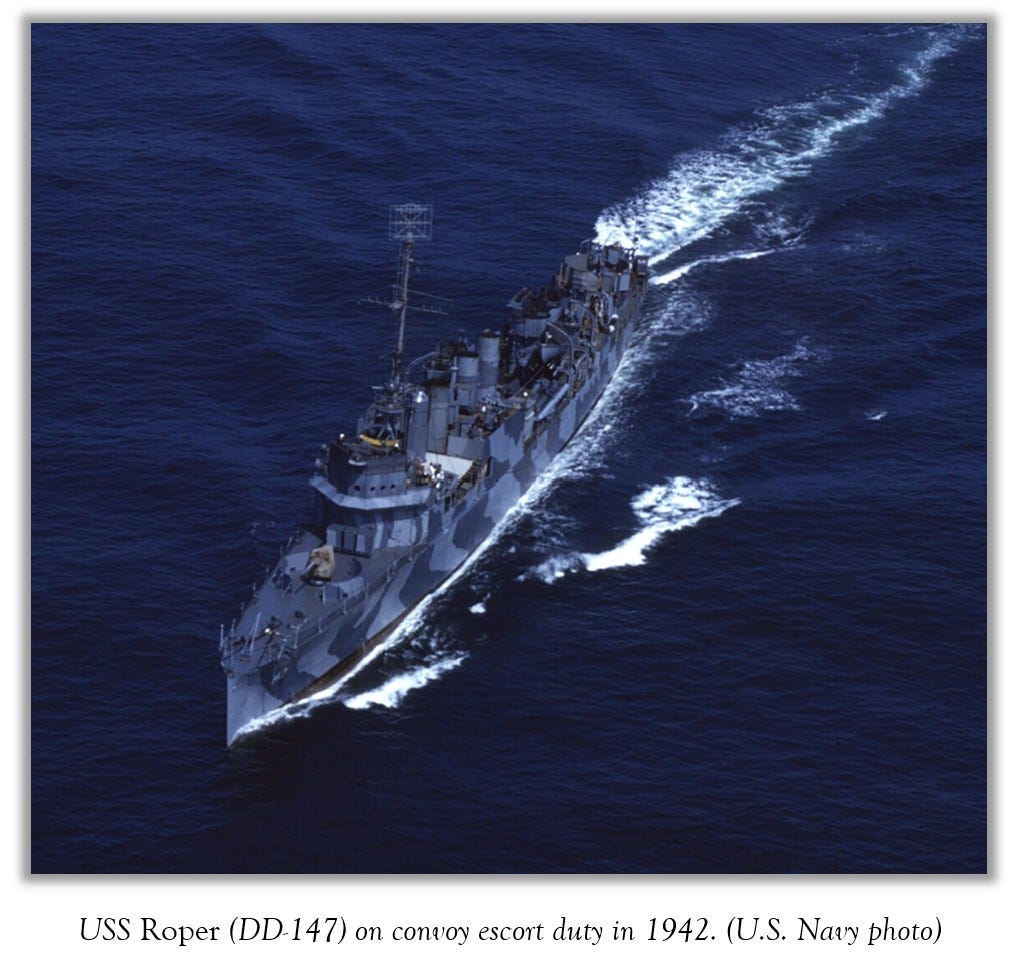
On this day in 1942, the United States Navy records its first sinking of a German U-boat during World War II. USS Roper wasn’t the biggest or the newest of our ships. To the contrary, she was a destroyer originally commissioned in 1919.
Naturally, she got the job done anyway.
U-boats were then a constant threat, and Roper was among those patrolling the waters along America’s eastern coast. Her crew had not yet spotted any German submarines.
“Have sighted lots of wrecked ships, life rafts and empty lifeboats,” sailor Robert Gillon wrote in his diary. “Early this morning passed through large patch of burned paint where another tanker or supply ship sunk . . . . Lord only knows what this night will bring.”
He couldn’t then know it, but “this night” would be one for the history books.
Roper was off the coast of North Carolina on the night of April 13-14, 1942. It was a clear night and the seas were calm—at first. The peace was shattered just after midnight when Roper’s radar picked up an object about 2,700 yards out. “Decision was made to investigate,” Roper’s action report relates.
Was it a Coast Guard craft or a fishing boat? Roper had experienced such false alarms before. Nevertheless, Lt. Cmdr. Hamilton W. Howe ordered Roper forward. Just then, the sound operator heard “rapidly turning propellers” in the water.
It was enough. Howe ordered his men to battle stations.
Roper was gaining ground, but the object was changing course, and it was able to pull off a tighter turn than the destroyer could. The object fired a torpedo, which narrowly missed Roper.
The object had given itself away.
Roper’s bright searchlight shone, revealing a German U-boat skimming across the ocean’s surface. “The captain gave the word to fire anything, and we were all scared,” Gillon wrote.
One man was struggling with a jammed machine gun when boatswain’s mate Jack Wright took over. He cleared the gun and opened fire, sweeping the U-boat deck with 50 caliber rounds. His action kept the Germans at bay.
“The machine gun was going back and forth, fore and aft,” radioman Rhodes Chamberlin later described. “The Germans would run behind the conning tower; when the machine gun would go aft, they’d run out forward. It was only 10 steps to their gun. . . . This seemed to go on for several minutes.”
In the meantime, Coxswain Harry Heyman scored a direct hit on the conning tower and water began pouring into the German submarine.
“Orders were given to fire a torpedo at the submarine,” Roper’s action report concludes, “but she disappeared before it was fired. The submarine apparently was scuttled inasmuch as she settled slowly and went down stern first. About forty of her crew were on deck and soon sighted in the water.”
What happened next was a bit controversial. Howe refused to go back for the survivors. He knew that U-boats sometimes traveled in packs, and he was worried about being a “sitting duck” if he stopped long enough to retrieve the men. Instead, he began dropping depth charges.
The next morning, 29 bodies were retrieved from the water. Some were in civilian clothes with American money and identification cards.
Was the U-boat planning to deliver spies to American shores? There is no way to know, but the civilian clothing added to the controversy.
Either way, the bodies were buried as quietly as possible. In the meantime, Navy divers went down to the German submarine, retrieving as much technology as they could.
“The officers and crew of the U.S.S. ROPER, as a whole, in their first enemy action . . . conducted themselves creditably,” Howe concluded.
Yet another little-known story of the Greatest Generation.

Sources can always be found on my website, here.
A great tidbit from WW II. Good to remember some fighting did take place just off the US coast. Thank you, Tara Ross, for keeping the memory of USS Roper alive.
Mark my vote that U-85 was carrying spies. Further, tactically, Howe did the right thing.