
TDIH: Robert Maxwell's Medal of Honor
He held a non-combat role and was only lightly armed. Nevertheless, “Maxwell’s courage was what held us together,” a fellow soldier reported.

On this day in 1945, a telephone wireman receives the Medal of Honor. Robert D. Maxwell was lucky just to be alive. Months earlier, near Besançon, France, he’d made a split-second decision, putting his own life on the line but saving the men around him.
But Maxwell did more than survive. He lived so long that he was the oldest living Medal of Honor recipient at the time of his passing in May 2019.
Perhaps Maxwell was an unlikely hero? His Quaker grandfather had been a huge influence on his life. “I envision myself as a conscientious objector,” he later told an interviewer, “but when Pearl Harbor happened and other people around me were going to war, I felt that it was not only my duty but my privilege to serve the country.”
Maxwell ended up in a non-combat position, stringing communication lines for his battalion. Except the (allegedly) non-combat position put him in harm’s way more than once. During the Italian campaign, he worked a vital repair job for three hours, under fire. Shrapnel was tearing great gashes in his legs, but he just kept going.
He came under fire again during September 1944 as the 3rd Infantry Division advanced on Besançon. Technician Fifth Grade Maxwell was working to string lines at a battalion observation post: The Americans were using a house with a large stone wall around it. Rifle companies were supposed to be guarding the right and left flanks of the post, but German troops unfortunately broke through.
The observation post was attacked during the wee hours of the morning.
Maxwell held a non-combat role, remember, so he was armed with only a .45 caliber pistol. Nevertheless, he held his own. “Maxwell’s courage was what held us together,” one of his fellow soldiers later reported. “The machine-gun fire was just clearing his head, but he sat there taking pot shots at everything that moved. Our wall was beginning to crumble, and I was thinking how nice it would be to get out of there, when a grenade came over the chicken wire, and hit the cement floor right at our feet.”
Maxwell’s first instinct was to throw it back. But the grenade was hard to find in the dark, and he realized he didn’t have time.
“[A]ll I could do was just grab my blanket, shove it up to my chest and drop on it,” he reported matter-of-factly.
The decision saved lives. “Bob made the conscious decision to throw himself upon a German grenade to save the lives of the men with him in his battalion’s forward command post,” one officer later described. “One of those men was his battalion commander, Lt. Col. Lloyd B. Ramsey. Had all the men in the command post been killed or wounded, the battalion’s attack may have been degraded as the chain of command was reestablished.”
Maxwell was knocked unconscious at first. When he woke up, he was alone. His fellow soldiers had evacuated, leaving him behind because they thought he was dead. Maxwell managed to drag himself toward the house where he found his platoon leader still preparing to leave. Together, the two managed to escape.
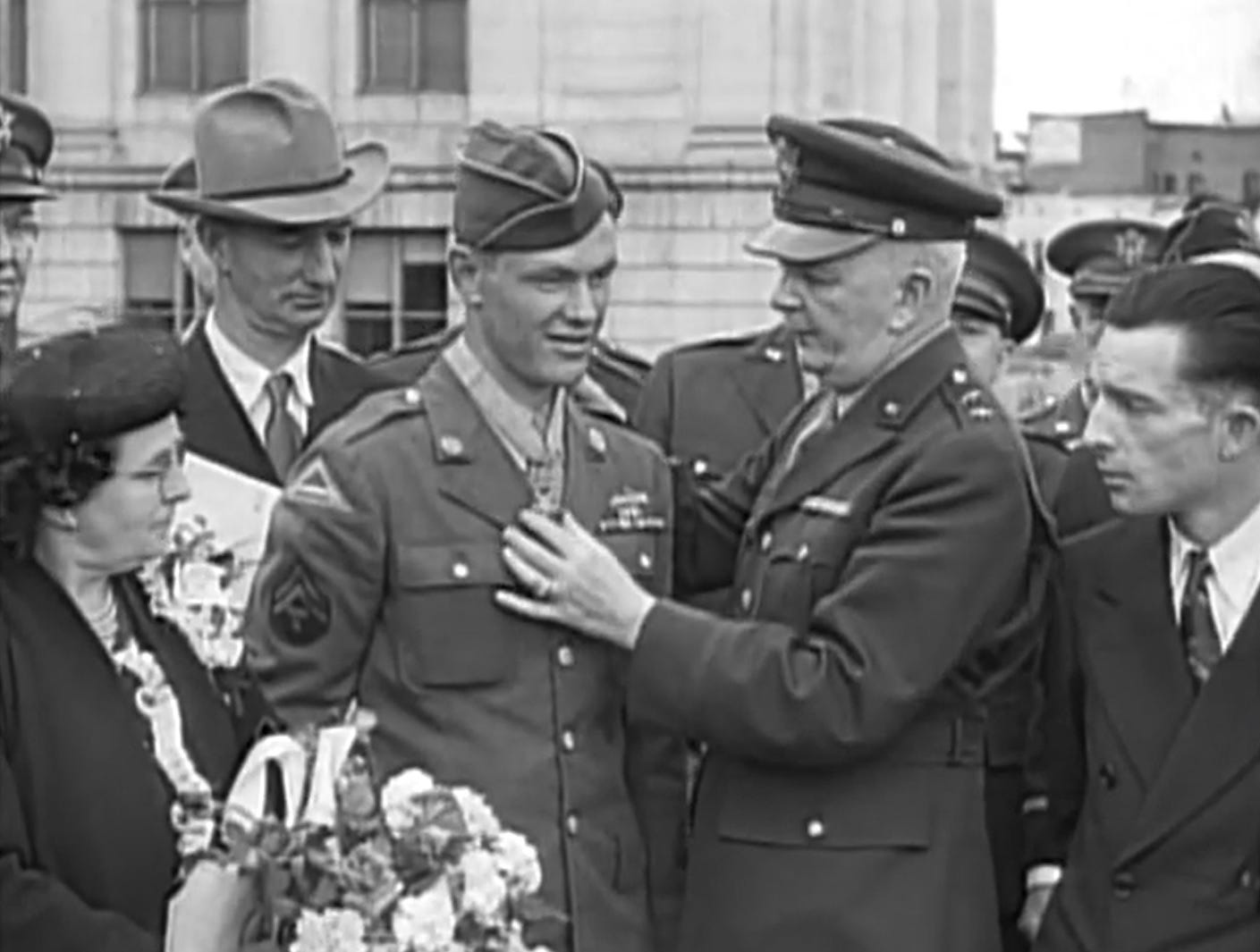
Maxwell would spend months in recovery before receiving the Medal of Honor in May 1945.
“It’s not the case that I was brave or a hero or anything like that,” Maxwell said of his Medal, “because I just did what the only alternative was at the time. And there was nothing else to do.”
I suspect we all beg to differ with that one?! RIP, Sir.

Sources can always be found on my website, here.
Robert Maxwell was among the best. It is a miracle that he survived the blast from the grenade. Such selfless actions are common traits of the Medal of Honor recipients. It was fortunate his commander had not left yet. Who knows if Maxwell would have made it out without his help.
Heroes = the folks that take action when, "...there was nothing else to do.” Thank you, Tara Ross, for keeping the memory of Robert Maxwell alive.