
TDIH: Battle of Okinawa
The American landing was barely contested, but our men knew what that meant: The Japanese were hunkered down elsewhere, ready to fight.

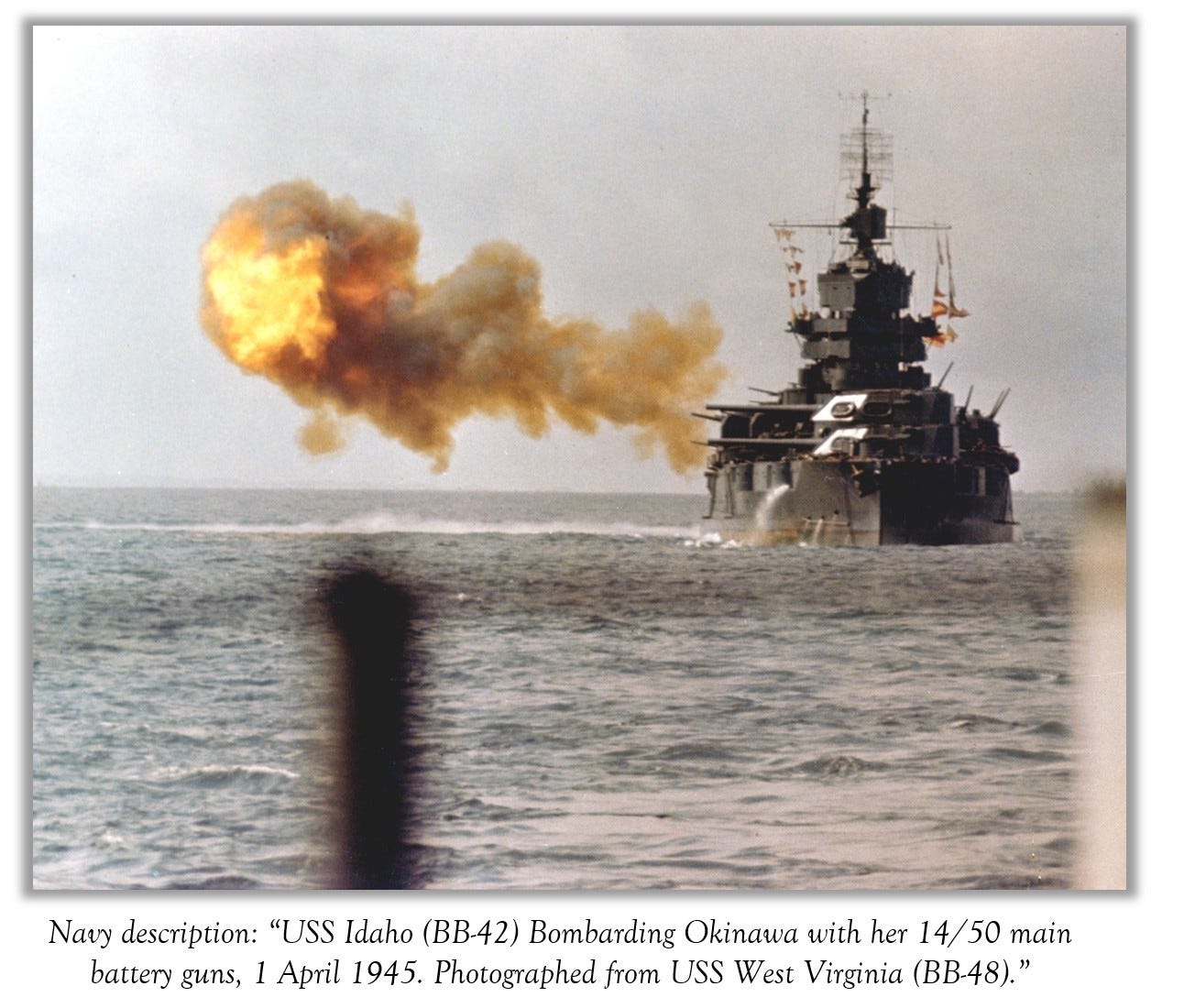
On this day in 1945, American soldiers and Marines land in Okinawa. They couldn’t then know it, but that campaign would stretch on for three long months, ultimately becoming the last and the biggest of the Pacific island battles during World War II.
It would also prove to be among the deadliest.
The war in the Pacific had been a grueling one. Americans employed a strategy of “island-hopping,” systematically taking tactically important Japanese islands, one at a time. Okinawa was the last and toughest of these. However, once it was captured, Allied forces would have a base of operations from which to attack mainland Japan.
The attack began on April 1 when more than 60,000 Marines and soldiers landed on one of Okinawa’s beaches. The American landing was barely contested, but American forces surely knew what that easy landing meant: The Japanese were hunkered down elsewhere, prepared to fight.
And that is exactly what happened for the better part of three months. The battle that followed was brutal, with hundreds of thousands of combatants facing off against each other. In the end, Americans lost 12,520 men (killed or missing), and more than 36,000 wounded. By contrast, about 110,000 Japanese died, and many civilians got caught in the crossfire.
The Japanese culture rejected the idea of surrender. Thus, ritual suicide and kamikaze attacks were not at all uncommon during this period. In some cases, soldiers even pressured civilians to take their own lives alongside them.
Indeed, as organized resistance finally came to an end on June 21, the Japanese commander, Mitsuru Ushijima, was already preparing for his own suicide. He wrote his last reports to his superiors, and he directly ordered one officer NOT to commit suicide! “If you die there will be no one left who knows the truth about the battle of Okinawa,” he told Major Yahara. “Bear the temporary shame but endure it. This is an order of your Army commander.”
Early on June 22, Ushijima committed ritual suicide, as did his second-in-command, General Isamu Cho.
Later that same morning, Americans raised the United States flag over Okinawa as a band played “The Star Spangled Banner.”
In the end, Americans never used Okinawa as a base from which to attack mainland Japan. The battle to capture the island had been so bloody and horrific that it helped push Harry S. Truman toward his decision. Atomic bombs would soon be used at Hiroshima and Nagasaki. After all, if the toll at Okinawa had been high, the price of invading mainland Japan would surely be even higher.
Those bombings, of course, prompted the Japanese emperor to announce his intent to surrender in August 1945. That surrender became official on September 2.
At that point, it had been nearly 4 years since the Japanese attack on Pearl Harbor. But the war was finally over.

Sources can always be found on my website, here.
Tara - thank you for your consistently thoughtful summaries of important battles and events in American history - and for this story about this most terrible conflict during the Pacific theatre of WWII .. including the fact that it brought Truman to his fateful decision.
And now, fortunately and ironically Japan is our trusted ally.
Such are the radical twists and turns of history - as they reawaken us to the sacrifices made by so many. The sacrifices of those fallen men must never be forgotten.
My father - a CB overseeing airfield construction - returned from that battle (and had witnessed Guadacanal’s intense fighting 1st hand).. my mother told me he returned a changed man, shaken surely and scarred but also full energy to live life to the fullest.
A sad but important history lesson, the loss of life was catastrophic on both sides. our ships under constant attack. My dad was stationed in the Philippines for the invasion of Mainland Japan, so thankful the atomic bomb that stopped that invasion from happening (sorry for the loss of civilian lifes). The loss of life from a mainland invasion would have been in the millions. A good reminder that war is hell.