
TDIH: Margaret Cochran Corbin
She is one of the patriotic women behind the folk hero "Molly Pitcher."

On this day in 1751, Revolutionary War patriot Margaret Cochran Corbin is born. Margaret is one of the patriotic women behind the folk hero “Molly Pitcher.”
“[Molly Pitcher] has held a revered place in the patriotic lore of the American Revolution,” one National Archives article concludes, “right next to Betsy Ross.” Yet no one is sure if one woman inspired the legend or if “Molly Pitcher is merely a persona created from numerous sources.”
Whether she was the true inspiration for Molly Pitcher or not, Corbin’s story deserves to be remembered.
Her story began on a tragic note: She was orphaned at a young age because of an Indian raid: With her father killed and her mother captured, Margaret was raised by an uncle.
She surely thought her life was taking a turn for the better in 1772: She left her uncle’s home and got married to John Corbin. The Revolution started soon afterwards, and Margaret followed her new husband into war.
We don’t know specifically what Margaret did during her time with the army, but she likely lived as so many other “camp followers” did in those years. The women who followed George Washington’s army would have helped in many ways: They were living a life far from home, washing clothes, cooking food, and mending uniforms.
Their contribution to the war effort was badly needed, although it surely felt rather menial and unglamorous.
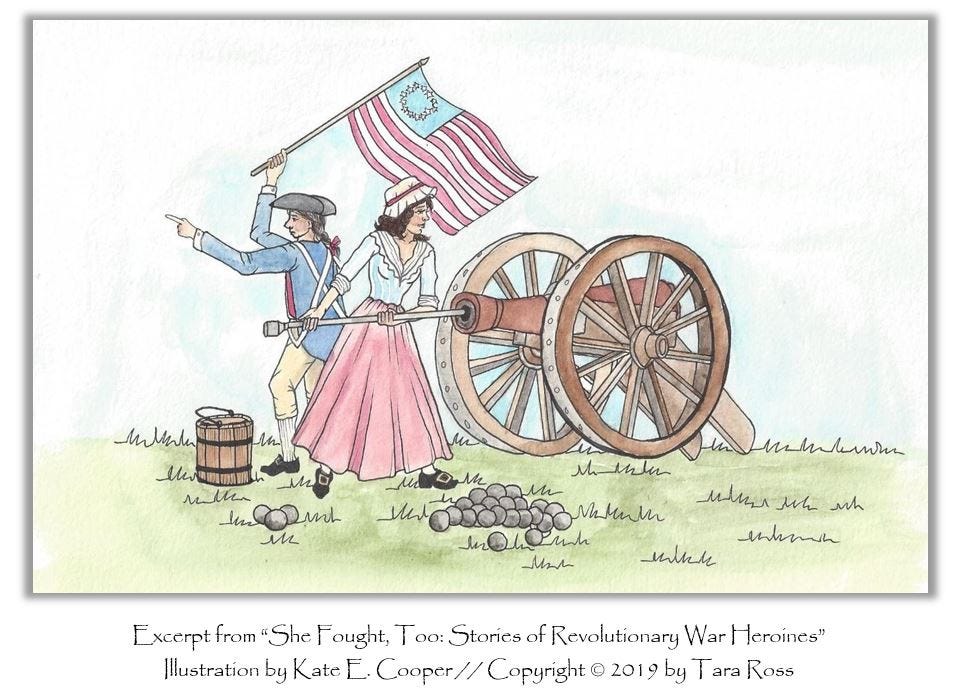
Then, Margaret did even more. Indeed, her efforts at the Battle of Fort Washington in 1776 were enough to grab the attention of the Continental Congress.
Margaret reportedly dressed in men’s clothing that day. She began helping her husband, who was working in the artillery line. John unfortunately took a mortal hit, but Margaret had no time for mourning: Instead, she stepped in and began firing the cannon herself.
Soon, Margaret was injured, too. Grapeshot injured her shoulder, chest, and jaw. When Americans surrendered, the wounded Margaret was captured, along with everyone else. Fortunately, she was released on parole, but Margaret had been permanently disabled by her wounds. She would never regain full use of her arm.
In 1779, the Continental Congress granted her a pension, but Margaret’s story still ended badly. It seems she never quite recovered from the losses that she suffered that day.
“When she died in 1800,” historian Carol Berkin concludes, “few local citizens realized that the sharp-tongued, alcoholic woman known as ‘Dirty Kate’ had taken ‘a soldier’s part in the war for liberty.’”
All sorts of sacrifices were made in the American fight for liberty, weren’t they?
Sources can always be found on my website, here.
Also: Friendly reminder that Molly Pitcher is one of the heroines featured in my kids’ book about Revolutionary War heroines. (Yes, I presented a more kid-friendly version of her story.) Signed copies available for Christmas gifts, here. Or Amazon’s cheaper price (because they can get cheaper shipping), here.
She truly gave her all. And it cost her dearly.
Thank you Tara for remembering some of those who are unsung heroes such as Margaret Cochran Corbin. Many others like her provided necessary services for our Revolutionary War soldiers. Those people are mostly unnamed so, to identify Margaret Cochran Corbin for the things she did in support of the war machine is important. In her case, following the death of her husband, she actually took over the firing of the canon.
Severely wounded, she was captured by the British before being released. She never fully recovered from her wounds and she had a miserable life after.
God bless this poor woman and all of the others who tirelessly worked in support of the war effort.