
TDIH: First American in Space
“Boy, what a ride!” Alan Shepard reportedly grinned. He was soon on the phone with President Kennedy who summarized the feelings of so many: “We are awfully pleased and proud of what you did.”

On this day in 1961, the first American astronaut rockets into space. Alan B. Shepard, Jr. traveled to an altitude of 116 miles above Earth, completing the mission known as Mercury-Redstone 3 while he sat in a small capsule that he’d named Freedom 7.
He landed in the Atlantic just 15 minutes and 28 seconds after launch.
The Apollo missions sent men to the moon, of course, but do you know about the Mercury missions that predated them? Ultimately, more than two dozen of these missions—both manned and unmanned—would answer basic questions about how we get humans to and from space.
Shepard remembered the competitiveness of NASA’s first group of astronauts, the Mercury Seven. Who would get the first job?
“Seven guys going for that one job,” he later remembered, laughing. “So on the one hand there was a sense of friendliness and maybe some support, but on the other hand, ‘Hey, I hope the rest of you guys are happy because I’m going to make the first flight.’”
NASA chose Shepard.
“[T]here I am looking at six faces looking at me,” Shepard said, “and feeling, of course, totally elated that I had won the competition. But yet almost immediately afterwards feeling sorry for my buddies . . . they were trying just as hard as I was and it was a very poignant moment because they all came over, shook my hand . . . .”
Just one test flight with a chimpanzee stood between Shepard and space. That flight was completed in January 1961, but it also encountered a problem that made NASA uncomfortable. Thus, another unmanned flight was scheduled before Shepard would be allowed to go. That delay gave the Soviets time to leap ahead in the space race: Cosmonaut Yuri A. Gagarin became the first human in space on April 12.
Nevertheless, NASA was finally ready on May 5. An estimated half a million people stood on Florida beaches, hoping for a glimpse of takeoff. “All the kids in town seemed to be on the beach with their parents,” one eyewitness told The Cleveland Press. “The schools nearby brought their children . . . . We listened on transistor radios to the countdown so we knew what was happening the whole time.”
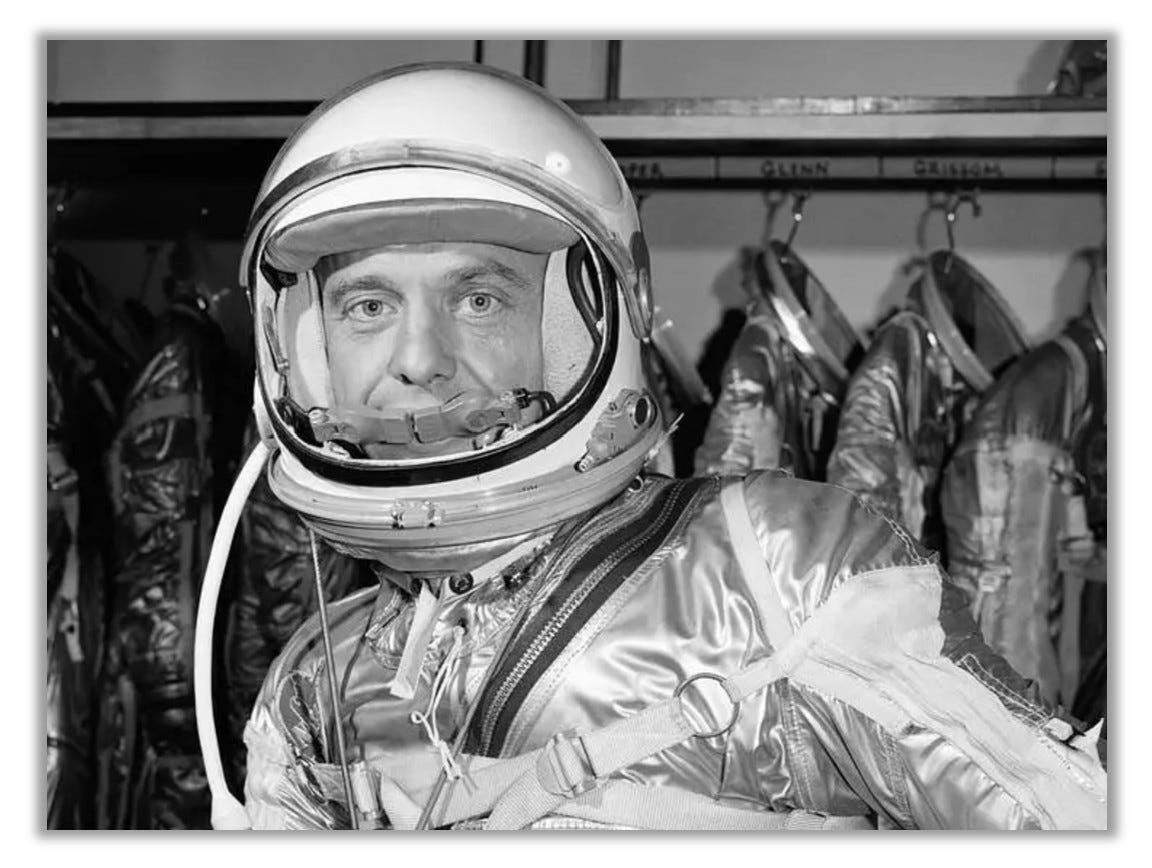
What must it have been like for Shepard, sitting atop that rocket, waiting to blast into the unknown?
But Shepard was a former Navy test pilot, and he faced the test accordingly, later saying he was mostly fascinated by “the challenge of being able to control a new vehicle in a new environment.”
Shepard lifted off at 9:34 a.m. E.T. “What a beautiful view!” he radioed as he broke into space. But he was soon at work because he had been entrusted with something that the Soviet cosmonaut had not.
“Shepard did Soviet cosmonaut Yuri Gagarin one better in at least one respect,” newspapers reported. “While the Russian’s Earth orbiting spaceship was fully controlled from the ground, Shepard was able to alter his vehicle’s altitude in the heavens.”
Freedom 7 reached her highest altitude just 5 minutes into flight. Shepard performed a necessary retro-fire maneuver to prepare for reentry. Ten minutes later, Shepard splashed down in the Atlantic where USS Lake Champlain recovered him.
“Boy, what a ride!” he reportedly grinned. He was soon on the phone with President Kennedy who summarized the feelings of so many: “We are awfully pleased and proud of what you did.”
Indeed, the successful mission prompted a promise from Kennedy just three weeks later. “I believe that this nation should commit itself to achieving the goal,” he famously said, “before this decade is out, of landing a man on the moon and returning him safely to the earth.”
And that, of course, is exactly what we did. Except this time, we beat Russia—and everyone else—to the punch.

Sources can always be found on my website, here.
The US space exploration through the years has been an exciting venture to follow. From Alan Shepard’s awesome ride right up to and including our most recent launch of the Artemis II we continue our quest to expand our knowledge of universe.
Amazing the bravery of these men sitting on a rocket that could blow up or fail, yet they all wanted to do it. Look how far we have come an how advanced we are compared to the early 60's. The moon again then Mars! Great story!